
What you get
- A dedicated project workspace per client or engagement, not a shared folder
- Deliverable documents with version history, right next to the work they describe
- A client-facing scheduling page backed by your Google Calendar, no back-and-forth
- E-signatures on the documents themselves for scope sign-off and approvals
- A kanban board for engagement tasks and milestones, scoped to that one client
- A lightweight CRM to track contacts and interactions across every engagement
The usual setup, and where it breaks down
Client work is scattered across five tools
A scope doc lives in Google Docs, the task list in a spreadsheet, scheduling in Calendly, contracts in DocuSign, and updates in email. Nothing is connected, so every status check means opening four apps to answer one question.
Each new client means another folder to set up from scratch
Kicking off a new engagement shouldn't mean rebuilding your task tracker, re-sharing a scheduling link, and re-explaining where the deliverables live. Independent consultants need a repeatable structure they can stand up in minutes, not an afternoon.
Deliverables and sign-off live in different places
The document a client needs to approve is rarely where they sign it. Exporting a doc, uploading it to a separate e-signature tool, and then tracking down the signed copy adds friction to the moment that actually closes an engagement.
| Progress | The usual stack | |
|---|---|---|
| Client structure | One project workspace per client, with its own board, docs, calendar, and files | A shared folder structure across Notion or Drive, organized by convention |
| Scheduling | Built-in booking pages synced to your Google Calendar | A separate Calendly subscription |
| Sign-off | E-signatures on documents inside the same project | A separate DocuSign or HelloSign account |
| Deliverable docs | Rich documents with version history, in the project they belong to | Google Docs or Word files, linked in from elsewhere |
| Client calls | Meetings with AI notes, joined from a plain link — no client account needed | Zoom plus a separate notetaker add-on |
| Cost | Free during the open beta | A subscription per tool, per client relationship |
One workspace per client, set up in minutes
Every client engagement gets its own project in Progress: a board, notes and documents, a calendar, files, and a scheduling page, all scoped to that project. Starting a new engagement means creating a new project, not assembling a new stack — the structure is already there, and nothing from one client bleeds into another.
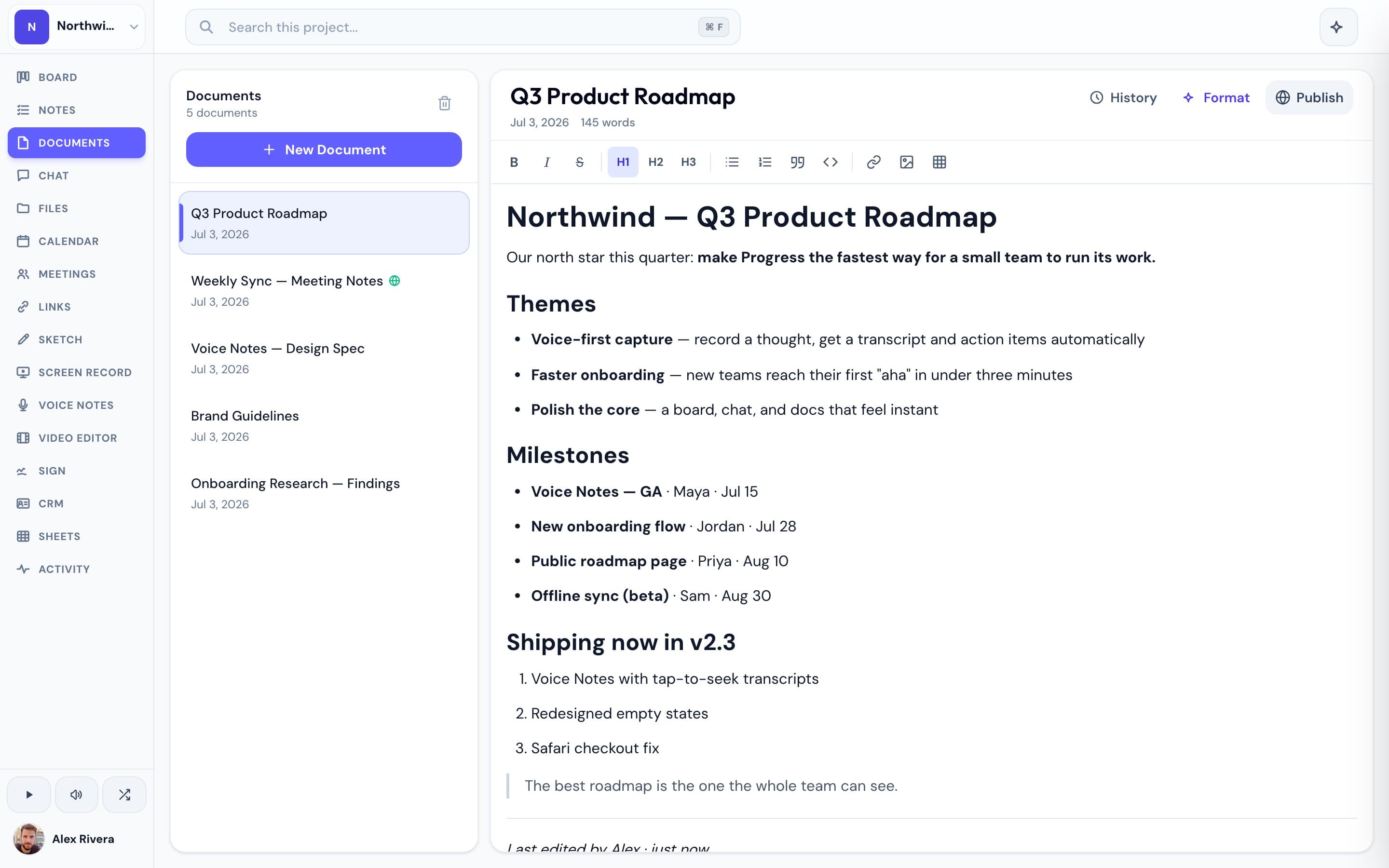
From proposal to sign-off without leaving the project
Write the scope document in Progress, share it with the client, and collect their signature on it with e-signatures — no separate DocuSign account, no exporting to a different tool. The signed document stays version-controlled inside the same project as the board and the calendar, so the paper trail for an engagement lives with the engagement.
Common questions
Can clients access their project without creating an account?
Clients can join meetings from a plain link and book time on your scheduling page without signing up for anything. Giving a client actual access to their project workspace does require an account, since that's how project permissions work.
Can I keep engagements completely separate from each other?
Yes. Each client gets its own project, and projects are the scoping boundary in Progress — one client's board, documents, and files don't show up in another's.
Is there a way to import my existing client docs from Notion or Google Drive?
There's no automated importer yet. Moving existing documents over is a manual process today; reach out through in-app support if you want help planning the move.
What does it cost?
Progress is free during the open beta.
Features that make it work
Compare
More use cases