
What you get
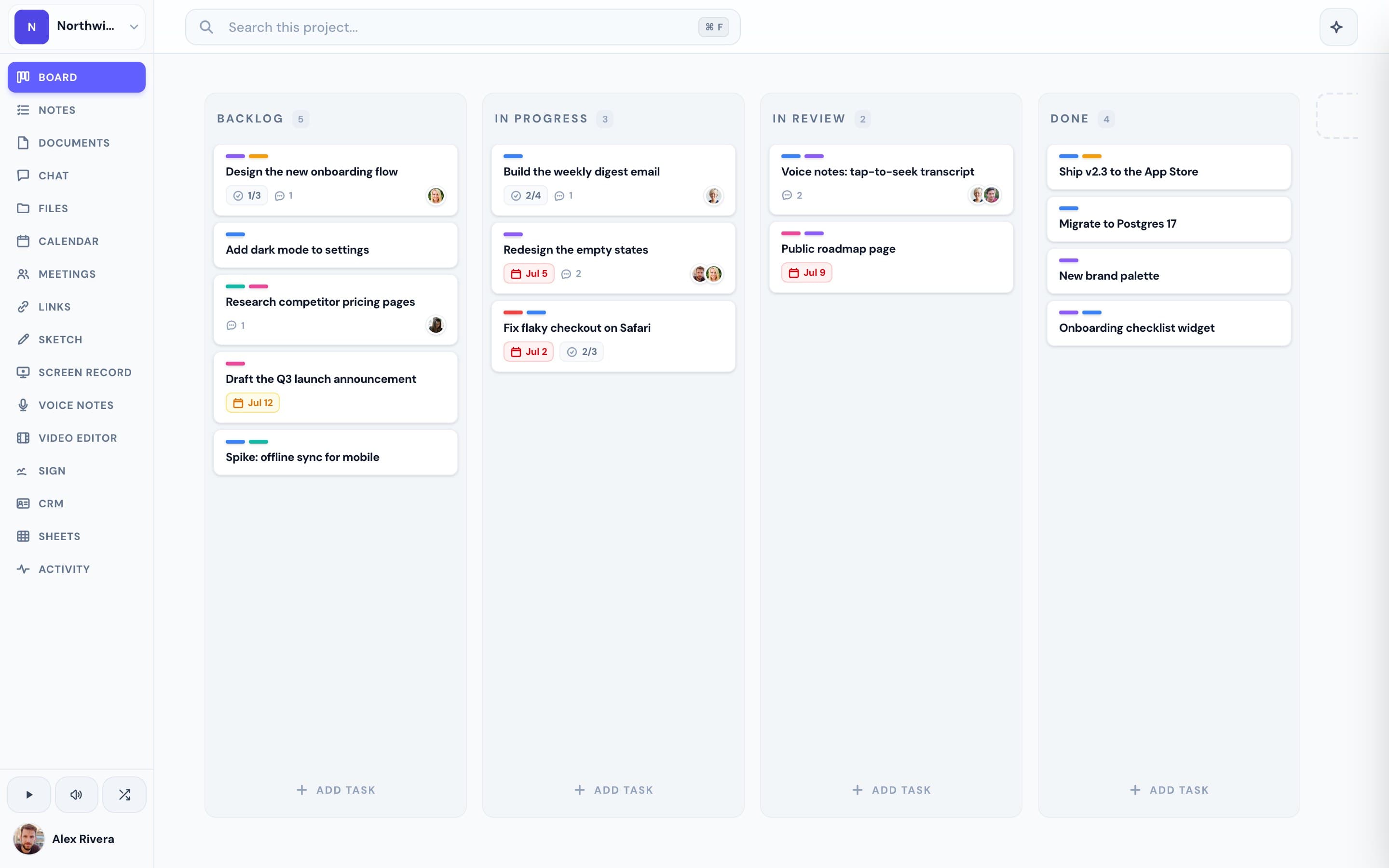
- One kanban board per project — columns, labels, due dates, checklists, and comments, no separate task tool required
- Real-time chat with channels and DMs scoped to the project, not one giant company-wide feed
- Notes and documents with version history, living next to the board instead of in a separate docs tool
- A calendar synced to Google Calendar, plus booking pages so clients can grab time without email back-and-forth
- Video meetings guests join from a plain link with no account, plus AI-generated meeting notes
- A lightweight CRM to track clients and contacts without a dedicated sales tool subscription
The usual setup, and where it breaks down
Five subscriptions for one small team
A five-person team ends up paying for a board tool, a chat app, a docs tool, a scheduling tool, and a video tool — five separate bills for tools that were never built to talk to each other.
Context scattered across apps
The task lives in one tool, the discussion about it lives in another, the spec is in a doc somewhere else, and the client call about it is a recording nobody transcribed. Piecing together what happened on a project means checking four apps.
Client-facing gaps nobody budgeted for
Small teams doing client work also need a booking link, a signed contract, and meeting notes — which usually means a scheduling plan, an e-signature plan, and a notetaker plan stacked on top of the internal tools.
| Progress | The usual stack | |
|---|---|---|
| Task board | Kanban board built into every project | A separate board tool, disconnected from chat and docs |
| Team chat | Project-scoped channels and DMs in the same workspace | A general company-wide chat app with no project boundaries |
| Docs & notes | Notes and documents with version history, next to the board | A separate docs tool, linked in but never really connected |
| Scheduling | Booking pages backed by Google Calendar, built in | A standalone scheduling tool subscription |
| Client meetings | Video calls guests join from a link, with AI meeting notes | A video tool plus a separate notetaker add-on |
| Pricing | Free during the open beta | Per-seat pricing stacked across every tool in the stack |
Everything scoped to the project
In Progress, a project isn't a folder — it's the workspace. The board, the notes, the calendar, the chat channel, and the client's contact record all live under the same project, so switching between them is a tab, not a different login. For a small team juggling a handful of active projects at once, that means less time spent remembering which tool has the thing you need.
Built for teams that also do client work
Small teams aren't just managing internal tasks — they're scheduling client calls, sending contracts, and running meetings someone outside the company needs to join. Progress includes booking pages backed by Google Calendar, e-signatures, and meetings guests can join from a link with no account, so client-facing work doesn't require a second stack of tools on top of the internal one.
One place to see where a project stands
Board activity, chat messages, and file uploads roll up into a project activity feed, so a small team can see what happened without reconstructing it from five different apps' notification histories.
Common questions
Is Progress free for small teams?
Yes — Progress is free during the open beta, for the whole workspace: board, chat, docs, calendar, and everything else covered above.
Can we bring over our existing Trello or Asana boards?
There's no automated importer yet. Moving cards over is a manual process today, and our in-app support can help if you get stuck.
Does Progress handle client-facing work, not just internal tasks?
Yes. Booking pages, e-signatures, and meeting notes are built in alongside the board and chat, so client work and internal work live in the same project instead of a separate stack of tools.
Is there a mobile app?
Yes, Progress has an iOS app alongside the web app, so the board, chat, and calendar are available on the go.
Features that make it work
Compare
More use cases