
What you get
- Drag-and-drop kanban board with labels, checklists, due dates, milestones, and burndown — scoped to each project
- Notes & Documents with version history, sitting next to the tasks they describe
- Real-time Chat (channels and DMs) and a Google-Calendar-synced Calendar in the same workspace
- Video Meetings guests join from a plain link with no account, plus AI meeting notes and booking pages backed by your calendar
- E-signatures, screen and video recording, a video editor, a sketch/whiteboard, voice notes, a lightweight CRM, and Sheets, all built in
- A project-aware AI assistant that can take actions across the workspace, not just answer questions
The usual setup, and where it breaks down
Your tasks live in one tool, everything about them lives in five others
The board says what needs to happen. The context for why lives in a Slack thread, the spec lives in a Google Doc, and the decision got made on a Zoom call nobody wrote down. Piecing it back together costs more time than the task itself.
Client-facing work means logging into someone else's tool
Booking a call means Calendly. Getting a contract signed means DocuSign. Running the call means Zoom, plus a notetaker bolted on after the fact. None of it is connected to the project it's actually for.
Notes, files, and decisions get orphaned outside the board
A card gets marked done, but the document it produced, the chat thread that shaped it, and the meeting where it was approved sit in three other apps with their own logins, notifications, and search boxes.
| Progress | The usual stack | |
|---|---|---|
| Task tracking | Kanban board with labels, checklists, due dates, milestones, and burndown, scoped to each project | A dedicated PM tool for boards and tasks |
| Docs & notes | Notes & Documents with version history, living in the same project as the tasks | A separate docs tool, linked back in with a pasted URL |
| Team chat | Real-time Chat with channels and DMs inside the project | A chat app running alongside the PM tool, with its own notifications |
| Meetings & scheduling | Video meetings guests join from a link with no account, AI meeting notes, and booking pages tied to your calendar | A video call app, a separate scheduler, and a bolted-on notetaker |
| E-signatures | Built-in Sign for sending and collecting signatures | A standalone e-signature subscription |
| Client tracking | A lightweight CRM in the same workspace as the project it's tied to | A standalone CRM disconnected from the delivery work |
One workspace instead of a stack of subscriptions
Most teams don't run project management software alone. They run a board tool, plus a docs tool, plus a chat tool, plus a scheduler, plus something for e-signatures, plus a video call app with a notetaker duct-taped on. Each one has its own login, its own notification settings, and its own copy of the truth. Progress puts all of it inside the same project: the board, the docs, the chat, the calendar, the meetings, the CRM, and the e-signatures share one workspace, so a card, a document, and the meeting it came out of are one click apart instead of three tabs apart.
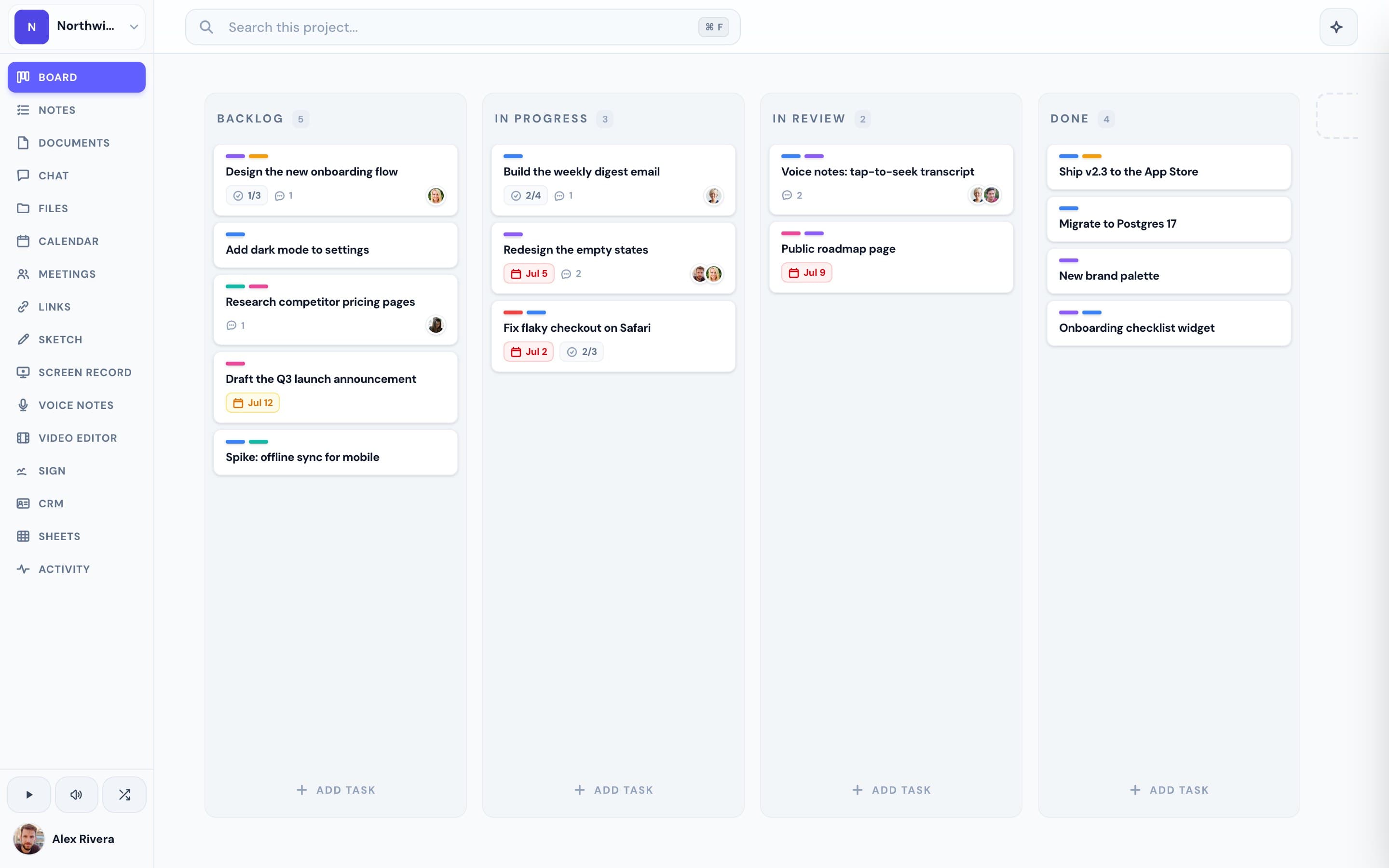
A kanban board built for how projects actually run
The board itself is a full kanban implementation, not a checklist with columns. Cards carry due dates, labels, checklists, file attachments, and threaded comments. Columns track a project's stages, and milestones plus a burndown chart give you a read on pace without exporting anything to a spreadsheet. Because the board lives inside the same project as everything else, a card's comment thread can point straight at a document, a chat channel, or a meeting recording instead of a pasted link to another app.
The client-facing side is built in too
Project management usually stops at internal task tracking and leaves client-facing work — booking time, running the call, getting something signed — to separate tools. Progress includes scheduling pages backed by Google Calendar so clients can book time without an email thread, video meetings guests join from a plain link with AI-generated meeting notes afterward, and e-signatures for the paperwork. A lightweight CRM keeps client and contact info in the same workspace as the project it's tied to, instead of in a separate system your project tool doesn't talk to.
Common questions
Is Progress just another kanban board tool?
No. Every project gets a full board, but the same project also holds notes and documents, chat, a calendar, meetings, files, a CRM, e-signatures, recording, and more. The board is the starting point, not the whole product.
Can I just use the board and ignore the rest?
Yes. The board works fine on its own — the other tools are there in the same project when you need them, not required to run a task list.
Can I move my team over from Trello, Asana, or Notion?
There's no automatic importer yet, so moving existing boards or docs over is manual. Reach out through in-app support and we can help you get set up.
What does Progress cost?
Progress is free during the open beta.
Features that make it work
Compare
More use cases