
What you get
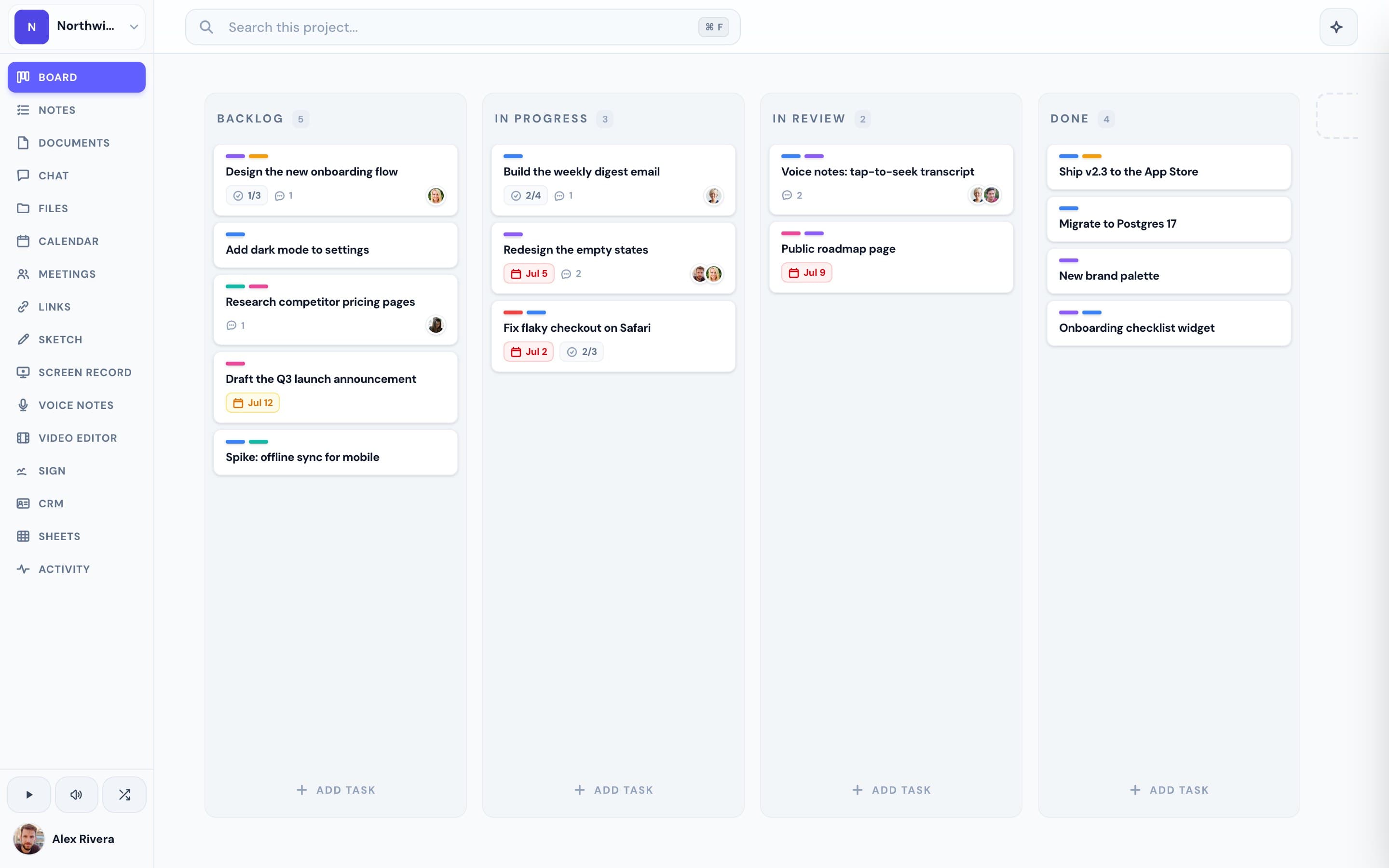
- Board, notes, chat, calendar, and files all scoped to the same project
- Meetings guests join from a plain link, no account needed, with AI meeting notes attached automatically
- Scheduling pages that book straight onto your Google Calendar
- e-Signature, screen recording, and a whiteboard without opening a separate app
- A project-aware AI assistant that can act across the board, notes, and calendar
- A lightweight CRM for tracking the people and clients behind the work
The usual setup, and where it breaks down
Your day lives in ten different tabs
Tasks in one app, notes in another, chat in a third, meetings in a fourth. Switching between them isn't free — it's the tax you pay every time you move from planning to doing.
The tools don't know about each other
A meeting happens in Zoom, notes go in Notion, the task gets created in Trello, and none of them reference each other. You end up being the integration layer, manually copying context from one app to the next.
Every new project means reassembling the stack
Before you write the first task, you're inviting people to five different tools, setting up a shared calendar, and figuring out where notes will live. The setup tax gets paid over and over, for every project.
| Progress | The usual stack | |
|---|---|---|
| Task & project tracking | Kanban board with cards, labels, due dates, and checklists in every project | A separate Trello or Asana board |
| Notes & docs | Notes and documents with version history, living next to the board | A separate Notion or Google Docs |
| Team chat | Channels and DMs scoped to the project | Slack or Teams, disconnected from the tasks |
| Meetings | Guests join from a link, no account, with AI meeting notes attached automatically | Zoom or Meet plus a separate AI notetaker |
| Scheduling | Booking pages backed by the same Google Calendar | A standalone Calendly account |
| e-Signature | Sign built into the workspace | A separate DocuSign subscription |
One workspace instead of a stitched-together stack
Most productivity setups are assembled, not designed — a task app here, a docs app there, a scheduling tool bolted on because the calendar app doesn't handle bookings. Progress starts from the opposite direction: every project is one workspace, and the board, notes, chat, calendar, meetings, and files are already part of it. There's no connecting them, because they were never separate to begin with.
Built for the whole day, not just the meetings
Productivity tools tend to specialize in one moment of the day — a calendar app owns your schedule, a notes app owns your writing, a chat app owns your conversations. Progress is built around the project instead of the moment, so the same workspace that holds this afternoon's meeting also holds the notes it generates, the task it creates, and the file it references.
For work and for you
Progress doesn't distinguish between a client project and a personal one — a workspace is a workspace. Use it to run a freelance engagement with a booking page and e-signatures, or to keep a personal project's notes, tasks, and files in one place instead of spread across apps you only half-remember to check.
Common questions
Is Progress really free to use?
Yes — Progress is free during the open beta. That covers the board, notes, chat, calendar, meetings, files, and the rest of the toolset described on this page.
Is this just for client work, or can I use it for personal projects too?
Both. A project in Progress is just a workspace — nothing about the board, notes, or calendar assumes a client on the other end. People use it to run freelance work and to keep personal projects organized in the same app.
I already use Notion, Trello, or Asana — can I bring my data over?
There's no automated importer yet. Moving existing tasks or notes into Progress is a manual process today, and our in-app support can help if you get stuck.
Does every project automatically get all these tools, or do I have to turn them on?
They're on by default. Board, notes, chat, calendar, meetings, files, and the rest aren't add-ons — they're part of every project from the moment you create it.
Features that make it work
Compare
More use cases