
What you get
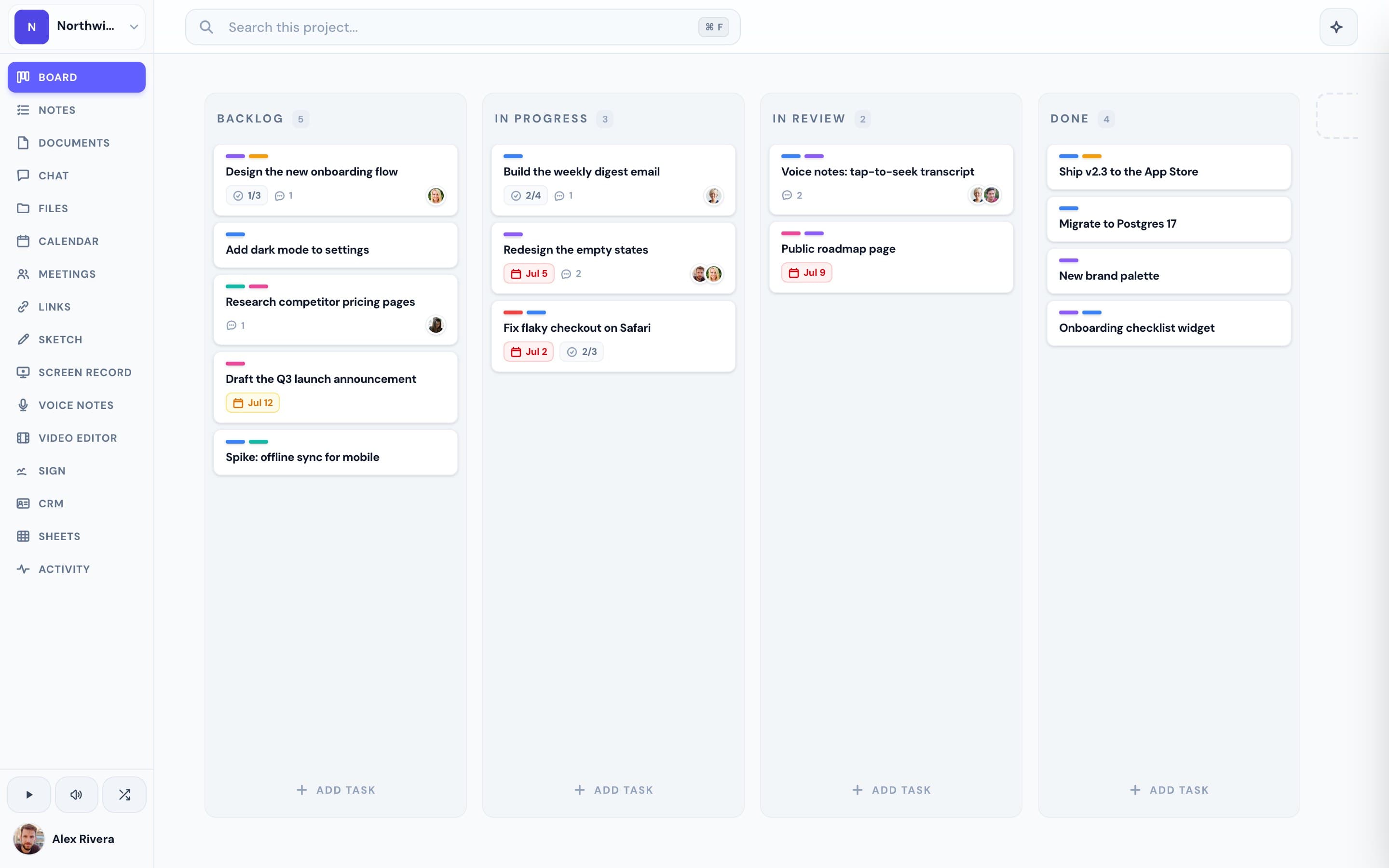
- A kanban board, notes and documents, chat, calendar, and files together in every project
- Video meetings guests join from a plain link, no account required, with AI-generated meeting notes
- Scheduling pages backed by Google Calendar for client bookings
- e-Signature for contracts and agreements without leaving the project
- A lightweight CRM that keeps client history next to the work it's about
- A project-aware AI assistant that can take actions across the workspace
The usual setup, and where it breaks down
Paying for six tools to run one project
A board app, a docs app, a chat app, a meeting tool, an e-signature tool, and a CRM add up — in cost, in logins, and in the time spent keeping them roughly in sync.
The context is never where you're looking
The contract is in one tool, the meeting notes are in a notetaker's dashboard, the task is on the board, and the client's history is in a CRM nobody updates. Finding the full picture means checking four tabs.
Integrations are brittle and someone has to own them
Zaps break, API keys expire, and native integrations lag behind both tools' updates. The all-in-one promise from a stack of point tools is really a maintenance job.
| Progress | The usual stack | |
|---|---|---|
| Board | A kanban board — cards, columns, labels, due dates, checklists — built into every project | A separate board tool like Trello or Asana |
| Docs | Notes and documents with version history, next to the tasks they describe | A separate docs tool like Notion or Google Docs |
| Chat | Real-time channels and DMs scoped to the project | Slack or Teams, disconnected from the board |
| Meetings | Video calls guests join from a link, no account needed, with AI meeting notes | A video tool plus a separate notetaker bot |
| Bookings & contracts | Scheduling pages backed by Google Calendar and e-signature, in the same workspace | A scheduler and an e-signature tool as two more logins to manage |
| Client CRM | A lightweight CRM tied to the project it's about | A standalone CRM, synced (or not) by integration |
One workspace instead of a stack
The usual way to run a project is to stitch tools together: a board app for tasks, a docs app for notes, a chat app for the team, a calendar app for meetings, a video tool for calls, a notetaker for minutes, an e-signature tool for contracts, a scheduler for bookings, and a CRM for client history. Each one needs its own login, its own integration, and someone has to keep them in sync. Progress skips the stitching. A project is one workspace, and the board, docs, chat, calendar, meetings, files, e-signatures, and CRM are already the same project — no exports, no syncing, no guessing which tool has the latest version.
Built for client work, not just internal tasks
Kanban boards are common. Less common is having the client-facing pieces in the same place as the work: a scheduling page backed by Google Calendar so clients can book time, video meetings they join from a link with no account, AI notes after the call, e-signature for the resulting contract, and a CRM entry that remembers all of it — tied to the project it's actually about. A freelancer or small team running client projects doesn't need five logins to get from first call to signed and scheduled.
Free during the open beta
Progress is free while it's in open beta. There's no per-seat pricing to configure and no feature gating to work around — every project gets the full set: board, docs, chat, calendar, meetings, files, e-signatures, CRM, and more. If you're moving from another tool, there's no automated importer yet; bringing boards, docs, or contacts over is a manual process, and in-app support can help if you get stuck.
Common questions
Does Progress replace every tool I use?
It covers the project-management core: board, docs, chat, calendar, meetings, e-signatures, files, and a lightweight CRM, all in one workspace. It's not trying to replace specialized software like accounting tools or a full enterprise sales CRM — for running projects and client work, it's built to be the only tool you have open.
Can I migrate my existing boards and docs into Progress?
There's no automated importer yet. Moving boards, docs, or contacts over is a manual process, and our in-app support can help if you get stuck.
What does it cost?
Progress is free during the open beta.
Is this for teams or for solo use?
Both work. Each project is its own workspace, so it fits a freelancer running client work on their own as well as a small team collaborating on the same board, docs, and chat.
Features that make it work
Compare
More use cases